
American Enlightenment Project
Change the Gun Debate,
End the Gun Violence Epidemic.
What is American Enlightenment Project (AEP)?
American Enlightenment Project is the only organization dedicated to ending the gun epidemic by overturning the Supreme Court decision that created it and correcting all the guesswork behind it.
Before Heller, there was no epidemic. Gun violence had been declining or flat for years. Courts uniformly held the 2nd Amendment “solely protects the right of the states to keep and maintain militia,” the only right debated at founding.
In 2008, in a “radical change,” Heller, by a slim 5-4 majority, found an implied right to a gun for self-defense, called “quite absurd” by dissenting Justice Stevens, of which there was “not a word” in the text or founding debates. The dissent’s own conjecture — “Surely it protects” an individual right to bear arms for militia duty — was mocked as a “right to be a soldier, an absurdity,” and not debated either.
By 2015, after Heller was extended in McDonald v. Chicago (2010) to gut handgun bans nationwide, guns and gun violence had surged to a ‘Gun Epidemic,’ as declared in a front-page New York Times editorial. In 2024, after Heller was expanded again in NYSRPA v. Bruen (2022) to allow public carry, the Surgeon General announced a ‘Public Health Crisis.’
Calling Heller ”the worst self-inflicted wound in Court history,” Justice Stevens warned it is “profoundly important” for Americans to understand its role in “the slaughter caused by the prevalence of guns.” He urged: “Overruling Heller is desperately needed.”
Launched on the 10th anniversary of Heller, AEP was formed to undo that egregious decision, expose its dangerous effects, and educate the courts and public on the real meaning of the 2nd Amendment.
This crisis has overtaken our ability to manage it. After Heller, guns and deaths soared in tandem, from 305 to 400 million guns and 31,500 to 45,000 annual deaths. Now 327 people a day are shot in this country, or “more than 200 wounded, 120 killed. The same number of deaths — 120 — will happen again tomorrow, the day after that, the day after that, every day, until we come to our senses and do something about it.” (Fareed Zakaria, Wash. Post 5.13.23)
Ending the crisis requires a paradigm shift — a change of basic assumptions in how we view Heller and understand the 2nd Amendment.
Why AEP?
AEP is the one gun violence prevention (GVP) organization to recognize that, to make sense of and end this epidemic, ONE MUST first identify the disease — Heller’s dangerous right to have a gun — then develop an effective cure:
- Mainstream GVP organizations advocate common-sense safety to “live with” Heller, and hundreds of millions are spent to fund their responses — modest reforms, grassroots efforts, electoral change — focused on symptoms, not the disease.
- A better approach is to develop a cure for Heller. Covid-19 vaccines followed decades of research, defying orthodoxy that mRNA would not work. That is the only way to end this epidemic, too, contrary to GVP orthodoxy it cannot be done.
- AEP’s counsel spent years finding both a cure for Heller and the 2nd Amendment’s lost meaning, upending common wisdom.
Despite clear evidence, mainstream organizations never identify the disease or ask why gun violence exploded in recent years. Why? Unable to change Heller, they choose to downplay or ignore the pernicious decision that puts Americans in peril.
Heller’s devastating, destabilizing consequences include:
- Mass shootings twice a day (@GunDeaths), road-rage shootings every 16 hours (@DefensiveGun), child shootings “EVERY DAMN DAY” (@DomesticGunViolence)
- A society living in fear, unable to protect itself
- Private militia, armed resistance, political violence
“As we face this crisis and are clear-eyed about the harm, let us also understand who is responsible” (Vice Pres. Kamala Harris on abortion, 1.22.24) —sage advice yet to be applied to gun violence.
Mainstream messaging that Heller is “not the problem” is wrong and deflects scrutiny. When the media reports “Little consensus on why gun sales and deaths are surging” and “There are too many shootings to cover” (Wash. Post 7.10.22, 7.11.22), it seldom mentions Heller’s radical change, just like mainstream organizations. Independent media finally called out Heller after the Highland Park July 4th parade massacre, in “America’s unique gun problem, explained” (Vox 7.4.22):
Heller “went much further” than possession to find a right of self-defense and to handguns, “responsible for far more deaths than any other weapon.” Bruen last year made reform “even harder,” and “the future of firearm regulation looks grim.” “The Court has made it impossible to cure America’s gun violence epidemic.”
“The Supreme Court disables the states’ responsibility to protect public safety, reduce gun violence, and safeguard public movement.“ Hawaii v. Wilson (Haw. 2024)
Mainstream slogans ‘we are winning’ and ‘play the long game’ are divorced from reality, even within the movement. The former leader of the Arizona chapter of Moms Demand Action explains:
“When I joined Moms in 2014, desperate to do something after the Sandy Hook Elementary massacre, 86 people were dying every day. Today it is 120. It became hard to claim the movement is ‘winning.’ Its goals and tactics made little dent, likely due to a taboo topic: the legitimacy of the right to guns found by Heller. In my time working on GVP, the surge in gun violence after Heller was never conceded much less questioned. I became demoralized fighting the same battles over and over. Marathon or sprint, we were not moving forward.”
GVP has let Heller’s devastating effects go unspoken for two decades.
“AEP gives me hope again. Overturning Heller is not easy but necessary. By restoring the 2nd Amendment to its purpose, we can end the source of this crisis and allow GVP strategies to gain traction.” (Geneva Haber 8.14.23)
Avoiding Heller, mainstream organizations — offering reassuring nostrums and marginal responses to its dangerous right, still insisting on their own absurd individual right (to serve in the miliitia) — simply are not focused on and can never cure the disease.
There is a short game, with a game-changing cure: undo Heller in the courts. We invite you to explore our Home page and the rest of AEP’s site, showing Heller’s consequences and glaring errors: Gun Crisis, 2nd Amendment Explained, andHeller’s 2nd Amendment. They provide information all should know about the Heller-fueled crisis and how to end it.
Who is AEP?
With its board and advisors, American Enlightenment Project is led by counsel with an accomplished record of resolving legal enigmas. After Sandy Hook, co-founder Robert Ludwig began years of in-depth research of the founding, Constitution, Enlightenment, and centuries of Anglo-American and other precedent, immersed in the “political and intellectual atmosphere” and “enormous mass of material” that Justice Scalia described.
Undeterred by conventional wisdom that the 2nd Amendment is unknowable and Heller invulnerable, AEP’s co-founder uncovered conclusive evidence of the amendment’s forgotten origins and meaning, making connections not obvious from how the record usually is read, and exposed glaring errors and omissions that require Heller be overruled.
- Mr. Ludwig applied the painstaking analysis used to end a decades-long inability of scholars and courts to explain similarly vexing text, persuading justices including Justice Scalia in a 2015 sovereign immunity case that “substantial contact,” an overlooked term of art, means “minimum contacts,” as recounted in The Foreign Sovereign Immunities Act: ‘Bedlam’ Redux (Law360 9.22.17). His earlier resolution of even older conflicts of law over air crashes on the high seas was unanimously adopted in 1990s aviation decisions by Justices Scalia and Thomas.
- His first Second Amendment article, 2nd Amendment Still Undecided, Hiding in Plain View (Law360 1.11.16), was published weeks after a “Gun Epidemic” was declared and weeks before Justice Scalia’s death. Other articles, available on AEP’s site, include: Court Pauses Joyriding with AR-15s, as Reality Catches Up to Coherent Nonsense (Nat’l Law J. July 21, 2025); High Court Gun Rights Case Ignores Key Case Law Problem (Law360 11.5.20); and Historic Legal Blunder that Enabled Our Gun Epidemic (Law360 4.28.18).
The Court already has vindicated one insight, that the amendment’s command “shall not be infringed” protects a public right. In 2018, a 7-2 Court reaffirmed that patent infringement involves a “public right,” over a dissent that “most everyone considered a patent a personal right.” That decision, correcting a related myth about patent infringement, ironically by Justice Thomas, a Heller stalwart and Bruen author, demonstrates how superficial assumptions can be undone — in this Court.
So does the Court’s decision this term that blocked unlawful deployment of the National Guard. One scholar’s brief clarified that “regular forces” in a militia statute meant regular military forces, not law enforcement as both sides superficially argued, avoiding unrest nationwide.
Prominent scholars are coming around, including Stanford historian Jack Rakove, Pulitzer Prize-winning author of Original Meanings, eminent James Madison and founding-era scholar, and lead historian on an amicus brief in Heller. Acknowledging the “basic omission regarding infringed,” he notes “if you don’t do the work and explore the specific usages common in the 18th century, you just can’t make sense of the story.”
“I agree with virtually everything in the AEP [site], including the nifty discussion of infringed.” (X@JRakove, 7.8.23)
What AEP Does
AEP is leading an effort to correct the superficial gun rights argued by both sides in Heller, contrary to longstanding jurisprudence and the Second Amendment’s actual meaning, in order to end this needless gun epidemic.
Heller is at the root of the Gun Epidemic
- As AEP’s Gun Crisis page shows: “To understand the real problem, google ‘Argument turns deadly.’” (A. Wiles tweet, 7.24.22). This crisis is not explained by mental health, poverty, or Covid, all found in other nations with a fraction of our gun violence.
- After Heller, gun deaths and shootings of all types rose and then accelerated, creating an inflection shown by virtually every metric.
- “Most murders are committed by law-abiding citizens where spontaneous violence is generated by anger, passion, or intoxication” (Justice Breyer).
- Empowering all citizens with guns, Heller turned those unable to control impulses into “criminals.”
“I am appalled by [the record shootings] but not mystified how it happens. The availability of guns everywhere and their use by people of all ages should be obvious. Until judges start reading the 2nd Amendment in a strict constitutional sense — i.e. that ‘militia’ means just that: an organized governmental armed force — this slaughter will continue.” (John Elsbree to Wash. Post ed. 1.9.24)
Both individual rights argued in Heller were wrong, even absurd
In Heller, both sides argued individual rights—to serve in the militia and to self-defense—neither debated at founding, and dismissed by the majority and dissents, respectively, as “an absurdity” and “absurd.”
- Throughout the 20th century, the unanimous view of federal judges, including conservative nominee and likely decisive vote, Robert Bork, was the 2nd Amendment “guaranteed the right of states to form militia, not for individuals to bear arms,” which “allowed states” to resist a “tyrannical national government.”
- In 1991, former Chief Justice Burger denounced an individual right as “the greatest piece of fraud”
- In 2008, the Heller Court did not address the existing state right to keep armed militia — the only right debated — because GVP advocates, who never lost a prior challenge to gun laws, chose to drop it.
Heller’s implied right of self-defense is absurd, as its many glaring errors show. But the right to serve in a militia that GVP advocates argued—a “sophisticated collective rights theory” — is just as absurd.
- D.C.’s counsel argued the right to serve was “invocable in court,” citing no case where it was invoked in 200 years, or any real support, and missing that the Court in 1827 rejected the idea of militia suits as “subversive of all discipline.”
- GVP advocates never defined their collective, nor could they: the only collective people in our system is the body politic—the state.
- Nor did they address the militia system for defense of the state, the focus of the unanimous U.S. v. Miller (1939) decision that led to uniform court recognition of the state right.
- Nor say how their right to serve in a militia (or on a jury as also imagined) could be a duty subject to fines or prison, unlike other rights.
- Explained as a “right to a gun…to fulfill the duty to serve in a militia” (NYU’s Michael Waldman, The Second Amendment, 2014) it made no sense.
- Argued as a right to a gun for militia duty but not self-defense — break glass for one emergency, not the other — the theory was not even plausible.
Dropping the longtime state right for a theoretical individual right, GVP advocates left the Heller majority no choice but to find the other individual right by default.
Following the herd — without independent thinking or review of their unsupported theory — GVP advocates all but invited Heller’s dangerous right that is leading the country over a cliff.
Justice Stevens in dissent, speculating “surely” the right to serve exists, could offer only lip service. Hedging, he noted: “the Amendment was designed to protect the right of each of the States to maintain a well-regulated militia.” In McDonald, he repeated: “It was the States on whose immediate behalf [it] was adopted.”
Deriding each other’s right, neither could explain why theirs was not debated. Nor account for Madison’s draft conscientious-objector exemption (“no person scrupulous of bearing arms shall be compelled to render military service”) — plainly superfluous under both a right of self-defense and to serve, but not a state right.
Such contradictions should have caused GVP legal advocates to see individual rights were dead ends and revert to the long-recognized state right, the only right consistent with the founding record. Blind to the consequences, they never mentioned it.
Heller is a historic blunder
Justice Stevens called Heller “the worst self-inflicted wound in Court history.” It’s worse than he knew.
- Citing dictionaries and little founding support, Heller rewrote the 2nd Amendment into constitutional artifice — “A disciplined citizens’ militia, being necessary to the security of a free polity, the right of individuals to have and carry a handgun in the home, shall not be abridged.”
A well regulated Militia, being necessary to the security of a free State, the right of the people to keep and bear Arms, shall not be infringed. – Amendment II
Among its glaring errors, Heller rewrote:
- well regulated as “disciplined” — reducing the country’s first constitution (from “well-regulated and disciplined militia” to “disciplined and disciplined militia”), and the amendment, to imbecility
- militia as “citizens’ militia” — conflating “citizen soldiers” and “militia” into an oxymoron
- the people as individuals — ignoring context: the opening clause it reduced to nonsense, and last clause it overlooked
- keep and bear as “possess and carry” — missing idiomatic uses of each term
- arms as personal weapons — repeating a “billy club” case’s mistake
- infringed as “abridged” — defining neither, carelessly transposing terms that are not even synonyms
Worse, the textualist Heller Court, purporting to decide the full text — each and every word — never address multiple terms, including the verb on which the amendment rests. Unlike abridged — used in the 1st Amendment (the Senate correcting House substitution of infringed) and all others since for personal rights — infringed was used in the 2nd Amendment and other organic laws like the first constitution (“the legislative right of any state . . . be not infringed”) to protect a public right.
Heller’s related right to “weapons typically possessed by law-abiding citizens for lawful purposes” rests on a fiction that military and personal weapons “‘were one and the same.’” Ignoring militia statutes specifying arms, it comes from a “billy club” case which miscited a swords encyclopedia that refutes it. (It was also Heller’s unattributed source for “citizens’ militia,” the first case to ever use that misnomer.)
Heller is not just wrong, but dangerous
The Heller majority said it was “aware of the problem of handgun violence in this country,” yet took “policy choices off the table” and guaranteed all Americans the right to have a gun. Heller’s dangerous new right triggered a predicable — and predicted — epidemic of guns and gun violence: impulsive, angry, intoxicated shootings; domestic violence, suicides, accidents; devastated homes, businesses, communities; ever-growing threats to personal safety and fear; and breakdowns in public safety, order, and the domestic tranquility promised in the Constitution.
Heller “curtails the power to regulate that contributes to” the “slaughter caused by the prevalence of guns” (Stevens, J.)

“The majority’s decision threatens severely to limit the ability of . . . officials to deal with gun-related problems” that “threaten the breakdown of law and order.” (Breyer, J.)
Miscalculating badly on the 2nd Amendment, Heller is responsible for not one “tragic act of mayhem,” but relentless mayhem nationwide. Each day, through mass shootings and less publicized but even more widespread carnage, countless Americans, families, and communities pay the price.
Heller’s related right, of “citizens’ militia as a safeguard against tyranny” if “constitutional order broke down” has inspired surges in private militia, armed resistance, and political violence. Endorsing a pernicious myth, the Court has normalized menacing public displays of military-grade weapons.
That was plain wrong. “Citizens’ militia” is an oxymoron that conflates “citizen soldiers” with “militia.” The States were meant to provide that constitutional safeguard, as Alexander Hamilton and Madison both explained. Worse, it‘s “productive of anarchy” as Blackstone warned, if each citizen can decide when order breaks down. The Court’s reckless rhetoric has bred political violence and militia plots to kidnap or assassinate political leaders, including a governor, vice president, even a Supreme Court justice.
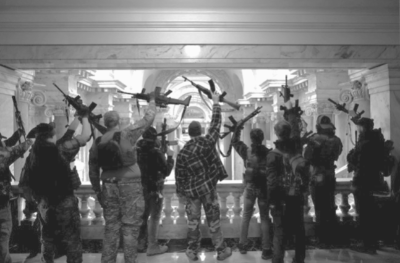
Heller has led to a doubling of pseudo militia, including the Three Percenters (2008), Oath Keepers (2009), Boogaloo Boys (2012), and Proud Boys (2016). Anarchy has resulted, sometime deadly, in Charlottesville, Lansing, and the U.S. Capitol on January 6 (Stewart Rhodes declaring the 2020 election “unconstitutional” with calls to “rise up in insurrection” and for “bloody civil war”; another insurgent claiming his “constitutionalist” right).
Heller cannot legally stand
Justice Stevens urged “overruling Heller is desperately needed,” but seeing no way to persuade this Court, advocated repeal instead. That is not only highly improbable, but fundamentally wrong as ignoring constitutional bedrock: the 2nd Amendment serves as an essential state check on federal tyranny. It is also unnecessary: overturning Heller is all but inevitable.
- Heller’s failure to decide the full text means, as is well established, it can have no binding effect
- Reconsideration is also warranted where Heller failed to address existing law — the state right
- Heller’s rewrite of 2nd Amendment terms — untenable on their face — reduced it to impermissible nonsense
- Heller’s superficial reading of the people as persons ignored context, founding concepts, and usage
- The Court undermined Heller in 2018, holding patent infringement involves a “public right”
- Heller itself recognized that a personal right “fits poorly” with well regulated militia unless rewritten as disciplined citizens’ militia — or nonsense
- Both individual rights argued in Heller were undebated at founding, without real support, and absurd, leaving the one actually debated: a state right
Almost all these plain errors and oversights have been missed, indicating Heller, the amendment, and founding are not closely read by lawyers, scholars, or courts. The start of a long list, they reveal Heller as a house of cards, waiting to be challenged and fall.
The 2nd Amendment protects a state right, and is no bar to gun reform
As long understood but never proven, the 2nd Amendment protects state militia. It has nothing to do with a personal right to guns that turns everyday angry impulses, that normally end in words, into today’s gun violence.
AEP explains what should be self-evident but has been missed about the amendment’s origins and meaning.
Under the first constitution, the States had an express right to keep and arm their militia. The amendment was drafted out of fears the new Constitution — that shifted to Congress the power to arm militia — left the States’ right to arm implied and subject to federal tyranny. They demanded it be made express, which is all that was debated.
How the amendment gave States what they demanded has mystified scholars and courts, who assumed away text, the first constitution, militia system, and key parts of the founding record.
Its real origins, object, and full text all prove the state right. AEP breaks down the precise use of language to reveal its meaning, including why the people means the States, and infringed protects a public right.
“Context is everything,” as Justice Scalia once said. Yet in Heller, both sides superficially assumed the amendment refers to persons, leading to undebated meanings. They missed the context and deeper meaning: the people in an amendment about militia for defense of the state — a public right — are the States.
Experts, relying on professional intuition, tend to take shortcuts and make false assumptions. “They are much too quick to jump to conclusions,” however wrongheaded and against their interest, and “much too slow to change.” (Daniel Kahneman, “Thinking, Fast and Slow”)
The 2nd Amendment is mysterious today because we no longer use its terms, inseparable from that era, and scholars and courts assume away what explains them. Suppose it were ratified last year and the only right debated was the States’ right to keep armed militia as a safeguard against federal tyranny. There would be no mystery what it meant.
AEP also shows that the 2nd Amendment, protecting a state right, is no bar to gun reform.
- “There is no reason why all pistols should not not be barred” (Douglas, J., 1972).
- Once Heller is overruled, Congress and the States will be free to regulate firearms as before, when there were no shooting drills in kindergarten and daily mass shootings.
- With 400-500 million guns, returning to pre-Heller levels can be hastened by common-sense classifications and bans, buybacks, licensing, mandated insurance, and restrictions on sales of ammunition.
Canada has our heritage, happy gun owners, and no epidemic. It classifies firearms as unrestricted (hunting rifles), restricted (handguns, semi-automatics) and banned (automatic weapons).
Australia and New Zealand show buybacks and bans work: “Few Australians would deny their country is safer today” (former PM Howard).
What you should know
Not only is it “profoundly important” to understand Heller’s role in “the slaughter caused by the prevalence of guns,” as Justice Stevens warned as early as 2014. To have any hope of change, it’s also important to understand what’s behind Heller and the epidemic it created.
Everyone has been guessing in determining dangerous gun rights
The Heller Court was guessing. So were scholars, who call the amendment “baffling” (Columbia law professor Michael Dorf) with “no definitive answer” what it means (Harvard’s Mark Tushnet in Out of Range). They assume it can never be explained, saying to claim otherwise is “blowing smoke” (Tushnet) or “likely wrong” (Fordham historian Saul Cornell). Giving up, they urge courts to defer to “deep commitments” to gun rights of some and “reasonable restrictions” of others, “without purporting to untangle” it (Harvard’s Cass Sunstein).
Guesswork is often wrong, as when it fails to consider the full text, record, and other things in plain sight. Or when based on superficial analysis — whether the dictionary-based textualism of Heller, or the linguistics approach of the dissents and GVP advocates.
“Knowledge is essential to understanding, which should precede judging.” (Brandeis, J.)
This epidemic is a tragedy that did not have to happen — had both sides not purported to alter the long states’ right understanding of the 2nd Amendment through guesswork.
Fatalism about cracking the amendment’s code is self-defeating — the framers knew what it meant — and proving fatal as Heller takes more and more legislative choices “off the table.”
Odd bedfellows: both NRA and GVP leaders back Heller’s right to a gun
After the Parkland high school massacre in 2018, Max Boot in “The 2nd Amendment is being turned into a suicide pact” (Wash. Post op-ed 2.15.18), cast blame on leaders, “primarily but not exclusively Republicans,” for “idolatrous worship” of the amendment.
Ironically, a long line of Democrats endorse the NRA’s claimed right to a gun for self-defense, derided as “the greatest piece of fraud” by conservative jurists the decade before Heller. Presidents Clinton, Obama and Biden all did, as do congressional shooting victims. Former Rep. Gabby Giffords (D-AZ), shot at a campaign event, “commend[ed] the Court for restoring our right to bear arms” and backs gun rights as head of the Giffords Law Center to Prevent Gun Violence. House leader Steve Scalise (R-LA), sponsor of a bill to force states to allow licensed carry, then shot at GOP baseball practice by a licensed gun owner, strongly backs gun rights.
Even the face of gun control in Congress, Sen. Chris Murphy (D-CT), wrote in The Violence Inside Us (2020), after cursory analysis: “I think Heller is basically correct” and “it’s time for my side to admit it.”
Today’s right, yesterday’s fraud.
GVP advocates “have righteous zeal and noble motives” but “fall into the trap of lamely insisting ‘We support the 2nd Amendment but also support responsible gun control’” — a “self-defeating strategy.” (Allan Lichtman, Repeal the 2nd Amendment, 2020).
GVP advocates have also been painfully slow to grasp the nature and magnitude of the threat of Heller’s dangerous freedom. And to wake up to the fact their personal right is a fraud, too.
So do GVP legal advocates. New York solicitor general Barbara Underwood was “quite content” to treat Heller as rightly decided in Bruen — an ill-advised concession in the case that extended Heller from the home to the streets. Harvard’s Laurence Tribe, whose American Constitutional Law editions cycle through all three meanings (“guarantee state sovereignty,” right to serve, right of self-defense), dismissed Justice Stevens’ efforts to overturn Heller in an op-ed, “The 2nd Amendment isn’t the problem” (Wash. Post 3.28.18), missing both the problem and real amendment.
But most GVP advocates deride Heller’s right of self-defense as absurd and nowhere found in the amendment. Yet they fail to see their own personal right theory—to bear arms in a militia—is just as absurd and unfounded.
Mainstream GVP studiously ignores Heller—the elephant in the room—and its consequences
- Heller boosts gun sales and deregulation, and blocks or chills all but marginal reform
- Heller creates a dystopia of citizens using guns in anger to settle disputes
- Heller inspires militia activity, armed resistance, and political violence
Talking around Heller and its guarantee of a dangerous freedom, mainstream GVP organizations are sleepwalking the country into a deepening, self-inflicted crisis.
Mainstream GVP lost every major 2nd Amendment case arguing a superficial, absurd right
- D.C. v. Heller (2008) (finding right to own a gun for self-defense, tossing a handgun ban in the District of Columbia)
- McDonald v. Chicago (2010) (extending Heller’s right nationwide, overturning a Chicago ban)
- Caetano v. Massachusetts (2016) (extending Heller’s right to stun guns)
- NYSRPA v. NYC (2020) (compelling NYC to drop restrictions on transporting licensed guns)
- NYSRPA v. Bruen (2022) (extending Heller to public carry, overturning N.Y.’s good-cause license law)
- Garland v. Cargill (2024) (tossing ATF bump-stock ban imposed after Las Vegas mass shooting as beyond statutory authority)
- U.S. v. Rahimi (2024) (upholding federal law to disarm abuser under temporary domestic-violence restraining order, upon finding of threat)
- Smith & Wesson Brands, Inc. v. Mexicanos (2025) (unanimous dismissal of Mexico’s suit against U.S. gun manufacturers)
- Bondi v. Vandestok (2025) (upholding ATF rule regulating ghost gun kits as statutorily allowed under the Gun Control Act of 1968)
In the two NYSRPA losses and Rahimi, a narrow, fact-specific win, a few GVP advocates finally brought amicus challenges to Heller. But repeating the unsupported, theoretical right to serve in a militia, which Heller (rightfully) rejected as “an absurdity,” they were predictably ignored.
Such hopeless challenges, not questioning the theory, use corpus linguistics (computer analysis) to argue bear arms was used almost exclusively for military service. But that usage also supports a state right, and makes the theory no less superficial and absurd.
To argue the meaning of terms in service of an absurdity — an individual right to bear arms in a militia — is to argue an absurdity.
In Rahimi, former Brady counsel Jon Lowy and Prof. Carl Bogus argued in an amicus brief “the right of the people to participate in a state militia,” still citing no support, which the Court also ignored. But like Justice Stevens, they added: the amendment “was solely concerned with protecting state authority from federal infringement.” It can’t be both. One is supportable, not absurd, and remains to be argued.
Mainstream GVP blames Heller’s progeny—missing the wolf that came as a wolf
Mainstream GVP invited the Court to find an individual right in Heller, and then avoided discussing its consequences for years. It now blames Bruen, which extended Heller in 2022 to public carry, for going beyond Heller’s presumptive exceptions and suggestion its right “is not unlimited.” But the problem has always been Heller — a radical change in the law and catastrophic defeat for gun control — that GVP advocates keep miscasting in rosy terms, deceiving us or themselves.
Contrary to mainstream GVP assurances — e.g., Duke’s Joseph Blocher and SMU’s Eric Ruben claimed Heller “gives blessing to a potentially wide range of regulation,” The 2nd Amendment allows more gun control than you think (Vox, 6.14.18) — Heller offered no legal blessing, only dicta which is unenforceable. Heller’s “presumptively lawful” exceptions for bans on concealed public carry, possession by felons and the mentally ill, sensitive places like schools and government, commercial sales, weapons of war — expressly left for future review — relate to 19th and 20th–century laws, not “founding-era historical precedent” that Heller itself requires. As such, most are unenforceable under Heller’s test, as demonstrated in Bruen which struck down New York’s 20th-century public carry law.
GVP advocates criticize Bruen as imposing a new test — a founding-era “analogue” — overlooking that Heller created it, as shown by Justice Breyer’s Heller dissent (“why would the majority require a precise colonial analogue to save a modern regulation?”). They likewise blame Bruen for its “historical tradition” inquiry, which also comes from Heller. And they assail Bruen for disallowing “interest-balancing,” but that also was “expressly rejected” by Heller, as recognized in McDonald.
The truth is, Heller came as a wolf, not in sheep’s clothing. Its presumed exceptions were so thin that, a decade before Bruen, an appellate judge who called Heller a “snow job,” Richard Posner, held he was compelled by Heller, despite its dicta, to gut Illinois’ ban on public carry, adding to Chicago’s record violence post-Heller. Likewise in Bruen, New York conceded Heller’s right to bear arms extended to public carry, notwithstanding its dicta.
As should have been obvious all along, it is Heller that “threatens to throw into doubt the constitutionality of gun laws,” as Justice Breyer warned, not Bruen. As is also obvious, Heller’s “dramatic upheaval” of gun law “desperately needs” to be overruled, as Justice Stevens warned, which mainstream GVP unwisely dismissed as “unhelpful” to their political agenda.
Rather than blame Bruen, mainstream GVP should view that latest defeat as a wake-up call to take seriously Justice Barret’s question at oral argument: “Was Heller rightly decided?”
“Often an issue will come clad in sheep’s clothing: the potential to effect important change must be discerned by careful analysis. But this wolf comes as a wolf.” — Morrison v. Olson (1988) (Scalia, J.).
“We add to the ever-growing chorus of courts that have implored the High Court to . . . reconsider its path entirely. Our Nation is gripped by deadly gun violence our founders never conceived. . . . We cannot help but wonder (and fear): What’s next?” — Barris v. Stroud Twp. (Pa. 2024)
The Court’s 6-3 supermajority is poised for even more perilous expansions of Heller
The Court heard two gun cases this term: Wolford v. Lopez (whether Hawaii may ban carrying handguns on private property open to the public absent owner consent), and U.S. v. Hemani (whether federal law may prohibit gun possession by persons who are “unlawful user[s] of or addicted to any controlled substance”). The more significant of the two, Hawaii’s public carry law, is expected to be struck down.
Other cases may soon be reviewed, imperiling more common-sense gun laws:
Assault rifles: Whether popular semiautomatic rifles (e.g., AR-15) are protected “arms” or are “dangerous and unusual” as weapons of war remains a leading unresolved — and perilous — issue. The Court recently denied review of a 4th Circuit decision upholding Maryland’s ban (with Justices Thomas, Alito, and Gorsuch dissenting and Justice Kavanaugh questioning the result, signaling the Court will take the issue soon), as discussed in Court Pauses Joyriding with AR-15s, as Reality Catches Up to Coherent Nonsense (Nat’l Law J. July 21, 2025). Two petitions (Viramontes v. Cook County; Nat’l Assn. for Gun Rights v. Lamont) are pending, with others waiting in the wings.
Previously, the Court similarly paused review of a preliminary 7th Circuit decision upholding Illinois’ ban, in Harrel v. Raoul, over a dissent by Justice Alito. Justice Thomas concurred, writing “It is difficult to see how” AR-15s “are not ‘Arms’ protected by” Heller given their common use, citing a dissent against D.C.’s assault weapons ban by then-Judge Kavanaugh. Thomas called the lower court’s analysis “nonsensical,” adding “if the Seventh Circuit ultimately allows Illinois to ban America’s most common civilian rifle, we can — and should — review” the case. “The Court must not permit” courts to relegate the amendment to “a second-class right.” That case also remains pending.
Absent a serious challenge to Heller, the Court will likely soon extend its “common use” fiction to AR-15s.
Large-capacity magazines: Multiple state bans on large magazines (typically over 10 rounds) have produced splits across federal and state courts — some find such magazines fall outside protected “Arms,” while others treat them as arms but uphold bans under historical-analogue analysis. Severa petitions (e.g., Duncan v. Bonta) have been repeatedly relisted and will also likely soon reach the Court.
Sensitive places: Heller in dicta carved out “sensitive places” (schools, government buildings), that Bruen, in more dicta, “assumed settled,” despite evidence that guns at founding were generally allowed in schools and legislatures, leaving that assumption open to challenge. And lower courts are split over what other locations qualify (transit, places of worship, parks, bars). The Court declined to decide the Hawaii sensitive-places issue in Wolford, but other cases, like Schoenthal v. Raoul involving a public-transportation ban, are pending.
Even if upheld, any such silos would offer little protection under Heller, for example, to students just outside their schools, to government officials, staff, and the public outside government buildings, and in the parking lots of restaurants and bars where alcohol is consumed.
Age-restrictions on public carry: Restrictions on public carry by 18-20 year-olds — on joyriding around town with loaded guns — have split lower courts over the historical evidence on minors and regulatory practice. For example, Pennsylvania sought review of a Third Circuit decision that struck down its law restricting carry by 18-20 year-olds as inconsistent with founding-era militia laws that required enrollment at ages 16-18, even as young as age 15. The issue is poised for review, with pending petitions including Paris v. Second Amendment Foundation.
Felon possession bans: The federal law barring firearm possession by persons convicted of felonies faces many challenges, especially by those with past nonviolent offenses. Most circuits uphold the ban; only the 3rd Circuit has struck down its application in a decades-old, nonviolent case. The Court has denied innumerable petitions, many recently, making this the least likely of Heller’s presumptive exceptions to be disturbed. But there is little historical evidence of such bans as noted by Justice Breyer in Bruen, and by then-Judge Barrett in an earlier 7th Circuit case: “founding-era legislatures did not strip felons of the right to bear arms simply because of their status as felons.” The issue remains unresolved, with a few petitions still pending, with others to follow.
How you can help
Profound change is needed. GVP advocates have lost nearly every major gun control decision in the Supreme Court. And their fall-back minimal gun safety responses have left American society unable to protect itself, except at the margins. This epidemic needs a real cure—NOW.
While litigation usually is one piece of a long-term strategy for constitutional change, the gun crisis arose after Heller’s “dramatic upheaval in the law” (Stevens, J.). The surest, quickest way to end this crisis is to overturn Heller.
“Constitutional wrongs do not right themselves.” (Ketanji Brown Jackson, J.)
That is the mission of the American Enlightenment Project. The only organization that recognized the need for and then developed a real response to Heller and its epidemic, AEP offers a strategic change:
- Effective challenges to overturn Heller in the courts, who created the epidemic and must end it
- Reinstated legislative ability to enact common-sense gun laws, upon policy choices legislatures, not courts, are suited to make
- Recovered meaning of the 2nd Amendment, which has nothing to do with a personal right
Our work is groundbreaking. But undoing a landmark decision, resolving a centuries-old constitutional mystery, and upending entrenched conventional wisdom, all take significant resources.
You can make a difference. Please make a donation to support AEP today.
Increased Urgency
The Supreme Court is now poised to extend Heller again to allow joyriding with AR-15s, whose ballistic impact Minneapolis’ police chief has described as ‘sickening and unacceptable.’
This term, the Court will determine whether AR-15 bans in Chicago, Connecticut, and elsewhere survive—or whether high-powered assault rifles are protected nationwide. Already last year, Justices Thomas, Alito and Gorsuch said it was ‘difficult to see’ how the states could ban AR-15s, the most popular rifle in America, under Heller’s (invented) common-use test.
After years of gun-control losses at the Court, AEP is taking a different approach: confronting the flawed Heller decision that created today’s gun-rights framework and resulting gun crisis. Last year, a single amicus brief corrected both sides’ arguments and helped prevent misuse of the National Guard. AEP believes a similar brief can correct the errors in Heller—before the Court makes the crisis worse.
Join Us Now
Funding is needed now—in 30 days—to prepare and file an effective amicus brief by October 28.
If you believe the country needs a better approach to gun violence, this is the moment to act. If you can open doors, open them now. If you can help fund this work, fund it now.
Get Involved
Your support can help restore a safer America for us all.
We are a non-profit 501(c)(3) organization. Gifts to
the American Enlightenment Project are tax-deductible.